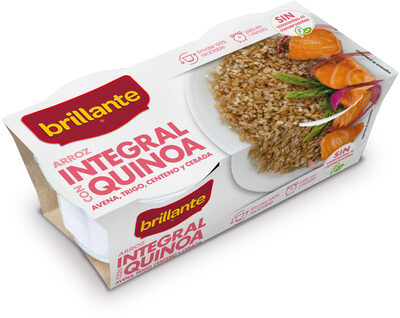

Arroz integral con quinoa - Brillante - 250 g (2 x 125 g)
Aquesta pàgina del producte no està completa. Podeu ajudar a completar-la editant-la i afegint-hi més dades a partir de les fotos ja disponibles, o fent-ne més amb l'aplicació de androide o iPhone / iPad. Gràcies!
×
Codi de barres: 8410184023931 (EAN / EAN-13)
Nom comú: Arroz integral con quinoa + 4 cereales
Quantitat: 250 g (2 x 125 g)
Empaquetament: Plàstic, en:container, es:Envase en cartón, es:Microondable, es:Vasito
Marques: Brillante
Categories: Aliments i begudes amb base vegetal, Aliments amb base vegetal, Cereals i patates, Llavors i grans, Cereals i derivats, Menjar preparat, Grans de cereal, Plats d'arròs, fr:Céréales préparées, Aliments a base de vegetals, en:Prepared rices
Etiquetes, certificacions, premis:
Sense conservants, Source of fibre, FSC, Punt verd, Alt en fibra, Sense colorants

Enllaç a la pàgina del producte en el lloc oficial del productor: https://www.brillante.es/productos/arroz...
Botigues: Carrefour, Alcampo, Eroski, El Corte Inglés, Hipercor, Condis, Caprabo, Bonpreu
Països on es va vendre: Espanya
Matching with your preferences
Salut
Ingredients


Processament d'aliments
-

Aliments ultra processats
Elements que indiquen que el producte està al grup 4 - Aliments i begudes ultraprocessats:
- Additiu: E322 - Lecitines
Els productes alimentaris es classifiquen en 4 grups segons el seu grau de processament:
- Aliments no processats o mínimament processats
- Ingredients culinaris processats
- Aliments processats
- Aliments ultra processats
La determinació del grup es fa en funció de la categoria del producte i dels ingredients que conté.
Additius
Anàlisi dels ingredients
-

No conté oli de palma
No s'han detectat ingredients que continguin oli de palma
-

Vegà
No s'han detectat ingredients no vegans
-

Vegetarià
No s'han detectat ingredients no vegetarians
-

Detalls de l'anàlisi dels ingredients
: Cereales 50% (cereales (trigo 10%, centeno 7%, avena 4%, cebada 4%), agua), arroz integral 37% (arroz integral, agua), quinoa 8% (quinoa, agua), aceite de girasol, sal, lecitina de girasol- Cereales -> en:cereal - vegan: yes - vegetarian: yes - percent_min: 50 - percent: 50 - percent_max: 50
- cereales -> en:cereal - vegan: yes - vegetarian: yes - percent_min: 25 - percent_max: 25
- trigo -> en:wheat - vegan: yes - vegetarian: yes - ciqual_proxy_food_code: 9410 - percent_min: 10 - percent: 10 - percent_max: 10
- centeno -> en:rye - vegan: yes - vegetarian: yes - ciqual_food_code: 9390 - percent_min: 7 - percent: 7 - percent_max: 7
- avena -> en:oat - vegan: yes - vegetarian: yes - ciqual_food_code: 9310 - percent_min: 4 - percent: 4 - percent_max: 4
- cebada -> en:barley - vegan: yes - vegetarian: yes - percent_min: 4 - percent: 4 - percent_max: 4
- agua -> en:water - vegan: yes - vegetarian: yes - ciqual_food_code: 18066 - percent_min: 25 - percent_max: 25
- cereales -> en:cereal - vegan: yes - vegetarian: yes - percent_min: 25 - percent_max: 25
- arroz integral -> en:brown-rice - vegan: yes - vegetarian: yes - ciqual_food_code: 9102 - percent_min: 37 - percent: 37 - percent_max: 37
- arroz integral -> en:brown-rice - vegan: yes - vegetarian: yes - ciqual_food_code: 9102 - percent_min: 18.5 - percent_max: 37
- agua -> en:water - vegan: yes - vegetarian: yes - ciqual_food_code: 18066 - percent_min: 0 - percent_max: 18.5
- quinoa -> en:quinoa - vegan: yes - vegetarian: yes - ciqual_food_code: 9340 - percent_min: 8 - percent: 8 - percent_max: 8
- quinoa -> en:quinoa - vegan: yes - vegetarian: yes - ciqual_food_code: 9340 - percent_min: 4 - percent_max: 8
- agua -> en:water - vegan: yes - vegetarian: yes - ciqual_food_code: 18066 - percent_min: 0 - percent_max: 4
- aceite de girasol -> en:sunflower-oil - vegan: yes - vegetarian: yes - from_palm_oil: no - ciqual_food_code: 17440 - percent_min: 4.4 - percent_max: 5
- sal -> en:salt - vegan: yes - vegetarian: yes - ciqual_food_code: 11058 - percent_min: 0 - percent_max: 0.3
- lecitina de girasol -> en:sunflower-lecithin - vegan: yes - vegetarian: yes - percent_min: 0 - percent_max: 0.3
- Cereales -> en:cereal - vegan: yes - vegetarian: yes - percent_min: 50 - percent: 50 - percent_max: 50
Nutrició
-

Molt bona qualitat nutricional
⚠ ️Atenció: la quantitat de fruita, verdura i fruits secs no s'especifica a l'etiqueta, s'ha fet una estimació a partir de la llista d'ingredients: 0Aquest producte no es considera una beguda per al càlcul de la Nutri-Score.
Punts positius: 8
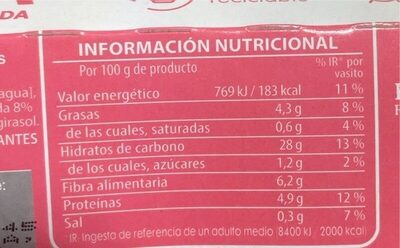
- Proteïnes: 3 / 5 (valor: 4.9, valor arrodonit: 4.9)
- Fibra: 5 / 5 (valor: 6.2, valor arrodonit: 6.2)
- Fruites, verdures, fruits secs i olis de colza/nou/oliva: 0 / 5 (valor: 0, valor arrodonit: 0)
Punts negatius: 3
- Energia: 2 / 10 (valor: 739, valor arrodonit: 739)
- Sucres: 0 / 10 (valor: 1.2, valor arrodonit: 1.2)
- Greixos saturats: 0 / 10 (valor: 0.6, valor arrodonit: 0.6)
- Sodi: 1 / 10 (valor: 120, valor arrodonit: 120)
Els punts per proteïnes es compten perquè els punts negatius són inferiors a 11.
Puntuació nutricional: (3 - 8)
Nutri-Score:
-

Nivells de nutrients
-

Greix en Quantitat moderada (4.3%)
Què us cal saber- Un alt consum de greixos, especialment de greixos saturats, pot augmentar el colesterol, que augmenta el risc de patir malalties del cor.
Recomanació: Reduïu el consum de greixos i greixos saturats- Trieu productes amb menys greixos i greixos saturats.
-

Àcid gras saturat en baixa quantitat (0.6%)
Què us cal saber- Un alt consum de greixos, especialment de greixos saturats, pot augmentar el colesterol, que augmenta el risc de patir malalties del cor.
Recomanació: Reduïu el consum de greixos i greixos saturats- Trieu productes amb menys greixos i greixos saturats.
-
Sucre en baixa quantitat (1.2%)
Què us cal saber- Un alt consum de sucre pot provocar augment de pes i càries dental. També augmenta el risc de patir diabetis tipus 2 i malalties cardiovasculars.
Recomanació: Limitau el consum de sucre i de begudes ensucrades- Les begudes ensucrades (com ara refrescos, begudes de fruites i sucs i nèctars de fruites) s'han de limitar tant com sigui possible (no més d'1 got al dia).
- Triau productes amb menor contingut de sucre i reduïu el consum de productes amb sucres afegits.
-
Sal comuna en Quantitat moderada (0.3%)
Què us cal saber- Un alt consum de sal (o sodi) pot provocar un augment de la pressió arterial, que pot augmentar el risc de patir malalties del cor i ictus.
- Moltes persones que tenen hipertensió no ho saben, ja que sovint no en tenen símptomes.
- La majoria de la gent consumeix massa sal (de 9 a 12 grams de mitjana al dia), al voltant del doble del nivell màxim d'ingesta recomanat.
Recomanació: Limitau la ingesta de sal i d'aliments rics en sal- Reduïu la sal que emprau quan cuinau, i no afegiu sal a taula.
- Limiteu el consum d'aperitius salats i trieu productes amb menor contingut de sal.
-

Entorn
-

Puntuació ecològica no calculada - Impacte ambiental desconegut
No hem pogut calcular l'Eco-Score d'aquest producte perquè li falten algunes dades, podríeu ajudar-nos a completar-lo?Podries afegir una categoria del producte més precisa perquè puguem calcular l'Eco-Score? Afegir una categoria
Empaquetament
-

Embalatge d'impacte mitjà
-
Peces d'embalatge
 (Plàstic)
-


Transport
-

Orígens dels ingredients
Falta informació sobre l'origen dels ingredients
⚠ ️ L'origen dels ingredients d'aquest producte no està indicat.
Si estan indicats a l'embalatge, podeu modificar la fitxa del producte i afegir-los.
Si sou el fabricant d'aquest producte, podeu enviar-nos la informació amb la nostra plataforma gratuïta per a productors.Add the origins of ingredients for this product Add the origins of ingredients for this product

Fonts de dades
Producte afegit per openfoodfacts-contributors
Última modificació de la pàgina del producte per duhowpi.
La pàgina del producte, també editada per existing, jaucafo, kiliweb, musarana, neptuno, packbot, roboto-app, sdianez, tacite-mass-editor, thaialagata, yuka.ZnI4L09iUllxT2NUbU05aTNqbng1UDE1eW9HM2ZHZTdKYlZOSVE9PQ, yuka.sY2b0xO6T85zoF3NwEKvlk9aSsHcgxnYFB7guReq5_WVCrfybYFD6a7wYqs, yuka.sY2b0xO6T85zoF3NwEKvlmJqesTGqzmVaQDTv0fX_86lH5LmY4l_-5PAMqg.