

Pechuga de pollo al corte - Hacendado - 200 g
Aquesta pàgina del producte no està completa. Podeu ajudar a completar-la editant-la i afegint-hi més dades a partir de les fotos ja disponibles, o fent-ne més amb l'aplicació de androide o iPhone / iPad. Gràcies!
×
Codi de barres: 8480000561626 (EAN / EAN-13)
Quantitat: 200 g
Empaquetament: Plàstic, en:pet-polyethylene-terephthalate
Marques: Hacendado
Categories: Productes amb base de carn, Carns, Carns preparades, Pollastre i derivats, Aus de corral, Pollastre
Etiquetes, certificacions, premis: Baix o sense greix, Baix en greixos, Lliure de gluten
Llocs de fabricació o processament: Barcelona, España
Codi de traçabilitat: ES 10.00121/B CE
Botigues: Mercadona
Països on es va vendre: Espanya
Matching with your preferences
Salut
Ingredients

Processament d'aliments
-

Aliments ultra processats
Elements que indiquen que el producte està al grup 4 - Aliments i begudes ultraprocessats:
- Additiu: E407 - Carragahen
- Additiu: E451 - Trifosfat
- Ingredient: Dextrosa
- Ingredient: Aromes
- Ingredient: Glucosa
Els productes alimentaris es classifiquen en 4 grups segons el seu grau de processament:
- Aliments no processats o mínimament processats
- Ingredients culinaris processats
- Aliments processats
- Aliments ultra processats
La determinació del grup es fa en funció de la categoria del producte i dels ingredients que conté.
Additius
Anàlisi dels ingredients
-

No conté oli de palma
No s'han detectat ingredients que continguin oli de palma
-

No és vegà
Ingredients no vegans: Pit de pollastre
-

No és vegetarià
Ingredients no vegetarians: Pit de pollastre
-

Detalls de l'anàlisi dels ingredients
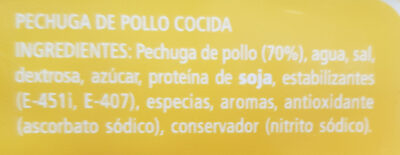
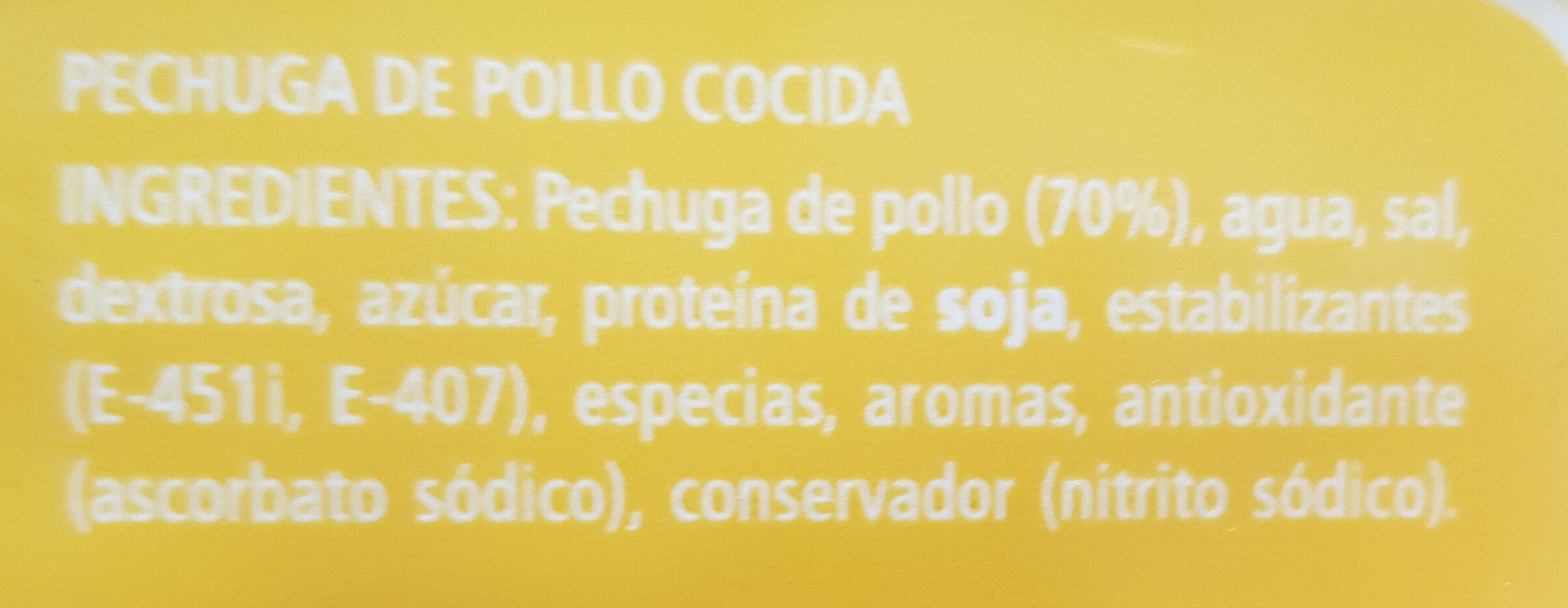
: pechuga de pollo 70%, agua, sal, dextrosa, azúcar, proteína de soja, estabilizante (e451i), estabilizante e407, especias, aromas, antioxidante (e301), conservador (e250)- pechuga de pollo -> en:chicken-breast - vegan: no - vegetarian: no - ciqual_food_code: 36018 - percent_min: 70 - percent: 70 - percent_max: 70
- agua -> en:water - vegan: yes - vegetarian: yes - ciqual_food_code: 18066 - percent_min: 15.8 - percent_max: 30
- sal -> en:salt - vegan: yes - vegetarian: yes - ciqual_food_code: 11058 - percent_min: 0 - percent_max: 1.9
- dextrosa -> en:dextrose - vegan: yes - vegetarian: yes - ciqual_proxy_food_code: 31016 - percent_min: 0 - percent_max: 1.9
- azúcar -> en:sugar - vegan: yes - vegetarian: yes - ciqual_proxy_food_code: 31016 - percent_min: 0 - percent_max: 1.3
- proteína de soja -> en:soy-protein - vegan: yes - vegetarian: yes - ciqual_food_code: 20591 - percent_min: 0 - percent_max: 1.3
- estabilizante -> en:stabiliser - percent_min: 0 - percent_max: 1.3
- e451i -> en:e451i - vegan: yes - vegetarian: yes - percent_min: 0 - percent_max: 1.3
- estabilizante e407 -> en:e407 - vegan: yes - vegetarian: yes - percent_min: 0 - percent_max: 1.3
- especias -> en:spice - vegan: yes - vegetarian: yes - percent_min: 0 - percent_max: 1.3
- aromas -> en:flavouring - vegan: maybe - vegetarian: maybe - percent_min: 0 - percent_max: 1.3
- antioxidante -> en:antioxidant - percent_min: 0 - percent_max: 1.3
- e301 -> en:e301 - vegan: yes - vegetarian: yes - percent_min: 0 - percent_max: 1.3
- conservador -> en:preservative - percent_min: 0 - percent_max: 1.3
- e250 -> en:e250 - vegan: yes - vegetarian: yes - percent_min: 0 - percent_max: 1.3
Nutrició
-
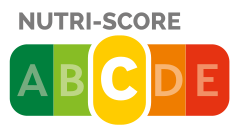
Qualitat nutricional mitjana
⚠ ️Atenció: la quantitat de fibra no s'especifica, no es tindrà en compte la seva possible contribució positiva en la qualificació.⚠ ️Atenció: la quantitat de fruita, verdura i fruits secs no s'especifica a l'etiqueta, s'ha fet una estimació a partir de la llista d'ingredients: 0Aquest producte no es considera una beguda per al càlcul de la Nutri-Score.
Punts positius: 5
- Proteïnes: 5 / 5 (valor: 16.9, valor arrodonit: 16.9)
- Fibra: 0 / 5 (valor: 0, valor arrodonit: 0)
- Fruites, verdures, fruits secs i olis de colza/nou/oliva: 0 / 5 (valor: 0, valor arrodonit: 0)
Punts negatius: 9
- Energia: 1 / 10 (valor: 354, valor arrodonit: 354)
- Sucres: 0 / 10 (valor: 1.3, valor arrodonit: 1.3)
- Greixos saturats: 0 / 10 (valor: 0.4, valor arrodonit: 0.4)
- Sodi: 8 / 10 (valor: 760, valor arrodonit: 760)
Els punts per proteïnes es compten perquè els punts negatius són inferiors a 11.
Puntuació nutricional: (9 - 5)
Nutri-Score:
-

Nivells de nutrients
-

Greix en baixa quantitat (1.2%)
Què us cal saber- Un alt consum de greixos, especialment de greixos saturats, pot augmentar el colesterol, que augmenta el risc de patir malalties del cor.
Recomanació: Reduïu el consum de greixos i greixos saturats- Trieu productes amb menys greixos i greixos saturats.
-
Àcid gras saturat en baixa quantitat (0.4%)
Què us cal saber- Un alt consum de greixos, especialment de greixos saturats, pot augmentar el colesterol, que augmenta el risc de patir malalties del cor.
Recomanació: Reduïu el consum de greixos i greixos saturats- Trieu productes amb menys greixos i greixos saturats.
-
Sucre en baixa quantitat (1.3%)
Què us cal saber- Un alt consum de sucre pot provocar augment de pes i càries dental. També augmenta el risc de patir diabetis tipus 2 i malalties cardiovasculars.
Recomanació: Limitau el consum de sucre i de begudes ensucrades- Les begudes ensucrades (com ara refrescos, begudes de fruites i sucs i nèctars de fruites) s'han de limitar tant com sigui possible (no més d'1 got al dia).
- Triau productes amb menor contingut de sucre i reduïu el consum de productes amb sucres afegits.
-

Sal comuna en alta quantitat (1.9%)
Què us cal saber- Un alt consum de sal (o sodi) pot provocar un augment de la pressió arterial, que pot augmentar el risc de patir malalties del cor i ictus.
- Moltes persones que tenen hipertensió no ho saben, ja que sovint no en tenen símptomes.
- La majoria de la gent consumeix massa sal (de 9 a 12 grams de mitjana al dia), al voltant del doble del nivell màxim d'ingesta recomanat.
Recomanació: Limitau la ingesta de sal i d'aliments rics en sal- Reduïu la sal que emprau quan cuinau, i no afegiu sal a taula.
- Limiteu el consum d'aperitius salats i trieu productes amb menor contingut de sal.
-


Entorn
-

Eco-puntuació D - Impacte ambiental alt
El Eco-Score és una puntuació experimental que resumeix els impactes ambientals dels productes alimentaris.→ L'Eco-Score es va desenvolupar inicialment a França i s'està ampliant per a altres països europeus. La fórmula Eco-Score està subjecta a canvis, ja que es millora periòdicament per fer-la més precisa i més adequada per a cada país.Anàlisi del cicle de vida
-

Impacte mitjà dels productes de la mateixa categoria: C (Score: 41/100)
Categoria: Chicken, meat and skin, raw
Categoria: Chicken, meat and skin, raw
- Puntuació ambiental PEF ( petjada ambiental de l'aliment ): 0.71 (com més baixa sigui la puntuació, menor serà l'impacte)
- incloent l'impacte sobre el canvi climàtic: 5.52 kg CO₂ eq/kg del producte
Etapa Impacte  Agricultura
82.8 %
Agricultura
82.8 % Processament
10.5 %
Processament
10.5 % Empaquetament
2.5 %
Empaquetament
2.5 % Transport
2.6 %
Transport
2.6 % Distribució
1.3 %
Distribució
1.3 % Consum
0.3 %
Consum
0.3 %
Bonificacions i punts negatius
-

Falta informació sobre l'origen dels ingredients
Punts negatius: -5
⚠ ️ L'origen dels ingredients d'aquest producte no està indicat.
Si estan indicats a l'embalatge, podeu modificar la fitxa del producte i afegir-los.
Si sou el fabricant d'aquest producte, podeu enviar-nos la informació amb la nostra plataforma gratuïta per a productors.
-
Embalatge d'impacte mitjà
Punts negatius: -8
Forma Material Reciclatge Impacte Unknown PET Alt ⚠ ️ La informació sobre l'embalatge d'aquest producte no és prou precisa (formes i materials exactes de tots els components de l'embalatge).⚠ ️ Per a un càlcul més precís de l'Eco-Score, podeu modificar la pàgina del producte i afegir-los.
Si sou el fabricant d'aquest producte, podeu enviar-nos la informació amb la nostra plataforma gratuïta per a productors.
Eco-Score per a aquest producte
-
Impacte per a aquest producte: D (Score: 28/100)
Producte: Pechuga de pollo al corte - Hacendado - 200 g
Puntuació de l'anàlisi del cicle de vida: 41
Suma de bonificacions i punts negatius: -13
Puntuació final: 28/100
-

Petjada de carboni
-

Equivalent a conduir 2.9 km en un cotxe de gasolina
552 g de CO² per cada 100 g de producte
La xifra d'emissions de carboni prové de la base de dades Agribalyse d'ADEME, per a la categoria: Chicken, meat and skin, raw (Font: Base de dades ADEME Agribalyse)
Etapa Impacte
Agricultura
75.1 %
Processament
14.9 %
Empaquetament
5.0 %
Transport
4.2 %
Distribució
0.7 %
Consum
0.1 %
Empaquetament

Transport
-
Orígens dels ingredients
Falta informació sobre l'origen dels ingredients
⚠ ️ L'origen dels ingredients d'aquest producte no està indicat.
Si estan indicats a l'embalatge, podeu modificar la fitxa del producte i afegir-los.
Si sou el fabricant d'aquest producte, podeu enviar-nos la informació amb la nostra plataforma gratuïta per a productors.Add the origins of ingredients for this product Add the origins of ingredients for this product

Fonts de dades
Producte afegit per kiliweb
Última modificació de la pàgina del producte per packbot.
La pàgina del producte, també editada per alexrios, date-limite-app, elcoco, inf, musarana, openfoodfacts-contributors, roboto-app, saisa, tacite-mass-editor, teolemon, thaialagata, yuka.UklrUklQZ1FpTjBweGNFKzVESHFvb2trbjUyMVVUTytPOEFXSWc9PQ, yuka.WVpza1FZRWN2L1FxaXNjYTFVamMvUGxaMmNPTFpHZVVkTTFLSUE9PQ.