Help us inform millions of consumers around the world about what they eat

group photo donation 2024
open food facts logo

Please give to our 2025 Fundraiser

Your donations fund the day-to-day operations of our non-profit association:

  • keeping our database open & available to all,
    • technical infrastructure (website/mobile app) & a small permanent team
  • remain independent of the food industry,

  • engage a community of committed citizens,

  • support the advancement of public health research.

Each donation counts! We appreciate your support in bringing further food transparency in the world.

arrow_upward

Energy – Coca Cola – 250 ml

Energy – Coca Cola – 250 ml

Aquesta pàgina del producte no està completa. Podeu ajudar a completar-la editant-la i afegint-hi més dades a partir de les fotos ja disponibles, o fent-ne més amb l'aplicació de androide o iPhone / iPad. Gràcies! ×

Codi de barres:
5000112640168(EAN / EAN-13)

Quantitat: 250 ml

Empaquetament: en:Metal, en:Recyclable Metals, Alumini, en:Can, de:AL, de:Einwegpfand
Einwegpfand

Marques: Coca Cola

Categories: en:Beverages and beverages preparations, Begudes, Begudes sense alcohol, en:Energy drinks, Begudes ensucrades

Botigues: Rewe, Netto

Països on es va vendre: França, Alemanya, Espanya

Matching with your preferences

Salut

Nutrició

  • icon

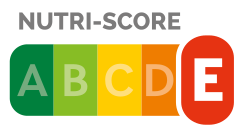
    Nutri-Score E

    Lower nutritional quality
    ⚠ ️Atenció: la quantitat de fibra no s'especifica, no es tindrà en compte la seva possible contribució positiva en la qualificació.
    ⚠ ️Atenció: la quantitat de fruita, verdura i fruits secs no s'especifica a l'etiqueta, s'ha fet una estimació a partir de la llista d'ingredients: 0
    • icon

      Discover the new Nutri-Score!


      The computation of the Nutri-Score is evolving to provide better recommendations based on the latest scientific evidence.

      Main improvements:

      • Better score for some fatty fish and oils rich in good fats
      • Better score for whole products rich in fiber
      • Worse score for products containing a lot of salt or sugar
      • Worse score for red meat (compared to poultry)
    • icon

      What is the Nutri-Score?


      The Nutri-Score is a logo on the overall nutritional quality of products.

      The score from A to E is calculated based on nutrients and foods to favor (proteins, fiber, fruits, vegetables and legumes ...) and nutrients to limit (calories, saturated fat, sugars, salt). The score is calculated from the data of the nutrition facts table and the composition data (fruits, vegetables and legumes).

      The display of this logo is recommended by public health authorities without obligation for companies.

    icon

    Punts negatius: 12/54

    • icon

      Energia

      3/10 points (177kJ)

      Energy intakes above energy requirements are associated with increased risks of weight gain, overweight, obesity, and consequently risk of diet-related chronic diseases.

    • icon

      Sucres

      9/10 points (10.4g)

      Un alt consum de sucre pot provocar augment de pes i càries dental. També augmenta el risc de patir diabetis tipus 2 i malalties cardiovasculars.

    • icon

      Sal

      0/20 points (0g)

      Un alt consum de sal (o sodi) pot provocar un augment de la pressió arterial, que pot augmentar el risc de patir malalties del cor i ictus.

    • icon

      Non-nutritive sweeteners

      0/4 points (0 edulcorant)

      Non-nutritive sweeteners may not confer any long-term benefit in reducing body fat in adults or children. There may be potential undesirable effects from long-term use of non-nutritive sweeteners, such as an increased risk of type 2 diabetes and cardiovascular diseases in adults.

    icon

    Punts positius: 0/18

    • icon

      Proteïnes

      0/7 points (0g)

      Foods that are rich in proteins are usually rich in calcium or iron which are essential minerals with numerous health benefits.

    • icon

      Fibra

      0/5 points (desconegut)

      Consuming foods rich in fiber (especially whole grain foods) reduces the risks of aerodigestive cancers, cardiovascular diseases, obesity and diabetes.

    • icon

      Detalls del càlcul de la Nutri-Score


      ⚠ ️Atenció: la quantitat de fibra no s'especifica, no es tindrà en compte la seva possible contribució positiva en la qualificació.
      ⚠ ️Atenció: la quantitat de fruita, verdura i fruits secs no s'especifica a l'etiqueta, s'ha fet una estimació a partir de la llista d'ingredients: 0

      Aquest producte es considera una beguda per al càlcul de la Nutri-Score.

      Points for proteins are counted because the product is considered to be a beverage.

      Puntuació nutricional: 12 (12 - 0)

      Nutri-Score: E

  • icon

    Informació nutricional


    Informació nutricional Com es ven
    per 100 g/100 ml
    Com es ven
    per porció (250 ml)
    Comparat amb: en:Energy drinks
    Energia 177 kj
    (42 kcal)
    442 kj
    (105 kcal)
    +28%
    Greix 0 g 0 g -100%
    Àcid gras saturat 0 g 0 g -100%
    Hidrats de carboni 10,4 g 26 g +40%
    Sucre 10,4 g 26 g +60%
    Fiber ? ?
    Proteïna 0 g 0 g -100%
    Sal comuna 0 g 0 g -100%
    Vitamin B3 1,6 mg 4 mg -77%
    Vitamina B6 0,15 mg 0,375 mg -84%
    Fruits‚ vegetables‚ nuts and rapeseed‚ walnut and olive oils (estimate from ingredients list analysis) 0 % 0 %
Mida de la porció: 250 ml

Ingredients

  • icon

    18 ingredients


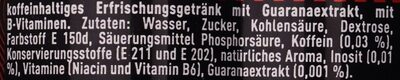
    Alemany: Wasser, Zucker, Kohlensäure, Dextrose, Farbstoff E 150d, Säuerungsmittel Phosphorsäure, Koffein 0,03%, Konservierungsstoffe (E 211 und E 202), natürliches Aroma, Inosit 0,01%, Vitamine (Niacin und Vitamin B6), Guaranaextrakt 0,001%
    • Ingredient information


      • Aigua: 73.8% (estimate)


      • Sucre: 5.2% (estimate)


      • E290: 5.2% (estimate)


      • Dextrosa: 5.2% (estimate)


      • Color: 5.2% (estimate)


      • — E150d: 5.2% (estimate)


      • Àcid: 2.7% (estimate)


      • — E338: 2.7% (estimate)


      • Cafeïna: 0.0%


      • Conservant: < 2% (estimate)


      • — E211: < 2% (estimate)


      • — E202: < 2% (estimate)


      • Aroma natural: < 2% (estimate)


      • Inositol: 0.0%


      • Vitamina: < 2% (estimate)


      • — Niacina: < 2% (estimate)


      • — Vitamina B6: < 2% (estimate)


      • Guaranà: 0.0%


  • icon

    Conté sucres afegits (~ 10%)

    Sucres afegits: Sucre, Dextrosa
    Quantitat estimada de sucres afegits en els ingredients: 10%
    Cerca productes de la mateixa categoria sense sucres afegits: Begudes ensucrades
    Què us cal saber
    • Un alt consum de sucre pot provocar augment de pes i càries dental. També augmenta el risc de patir diabetis tipus 2 i malalties cardiovasculars.

    Recomanació: Limitau el consum de sucre i de begudes ensucrades
    • Les begudes ensucrades (com ara refrescos, begudes de fruites i sucs i nèctars de fruites) s'han de limitar tant com sigui possible (no més d'1 got al dia).
    • Triau productes amb menor contingut de sucre i reduïu el consum de productes amb sucres afegits.

Processament d'aliments

Additius

  • E150d


  • E202 - Sorbat de potassi


    Potassium sorbate: Potassium sorbate is the potassium salt of sorbic acid, chemical formula CH3CH=CH−CH=CH−CO2K. It is a white salt that is very soluble in water -58.2% at 20 °C-. It is primarily used as a food preservative -E number 202-. Potassium sorbate is effective in a variety of applications including food, wine, and personal-care products. While sorbic acid is naturally occurring in some berries, virtually all of the world's production of sorbic acid, from which potassium sorbate is derived, is manufactured synthetically.
    Origen: Wikipedia (Anglès)
  • E211 - Benzoat de sodi


    Sodium benzoate: Sodium benzoate is a substance which has the chemical formula NaC7H5O2. It is a widely used food preservative, with an E number of E211. It is the sodium salt of benzoic acid and exists in this form when dissolved in water. It can be produced by reacting sodium hydroxide with benzoic acid.
    Origen: Wikipedia (Anglès)
  • E290 - Diòxid de carboni


    Carbon dioxide: Carbon dioxide -chemical formula CO2- is a colorless gas with a density about 60% higher than that of dry air. Carbon dioxide consists of a carbon atom covalently double bonded to two oxygen atoms. It occurs naturally in Earth's atmosphere as a trace gas. The current concentration is about 0.04% -410 ppm- by volume, having risen from pre-industrial levels of 280 ppm. Natural sources include volcanoes, hot springs and geysers, and it is freed from carbonate rocks by dissolution in water and acids. Because carbon dioxide is soluble in water, it occurs naturally in groundwater, rivers and lakes, ice caps, glaciers and seawater. It is present in deposits of petroleum and natural gas. Carbon dioxide is odorless at normally encountered concentrations, however, at high concentrations, it has a sharp and acidic odor.As the source of available carbon in the carbon cycle, atmospheric carbon dioxide is the primary carbon source for life on Earth and its concentration in Earth's pre-industrial atmosphere since late in the Precambrian has been regulated by photosynthetic organisms and geological phenomena. Plants, algae and cyanobacteria use light energy to photosynthesize carbohydrate from carbon dioxide and water, with oxygen produced as a waste product.CO2 is produced by all aerobic organisms when they metabolize carbohydrates and lipids to produce energy by respiration. It is returned to water via the gills of fish and to the air via the lungs of air-breathing land animals, including humans. Carbon dioxide is produced during the processes of decay of organic materials and the fermentation of sugars in bread, beer and wine making. It is produced by combustion of wood and other organic materials and fossil fuels such as coal, peat, petroleum and natural gas. It is an unwanted byproduct in many large scale oxidation processes, for example, in the production of acrylic acid -over 5 million tons/year-.It is a versatile industrial material, used, for example, as an inert gas in welding and fire extinguishers, as a pressurizing gas in air guns and oil recovery, as a chemical feedstock and as a supercritical fluid solvent in decaffeination of coffee and supercritical drying. It is added to drinking water and carbonated beverages including beer and sparkling wine to add effervescence. The frozen solid form of CO2, known as dry ice is used as a refrigerant and as an abrasive in dry-ice blasting. Carbon dioxide is the most significant long-lived greenhouse gas in Earth's atmosphere. Since the Industrial Revolution anthropogenic emissions – primarily from use of fossil fuels and deforestation – have rapidly increased its concentration in the atmosphere, leading to global warming. Carbon dioxide also causes ocean acidification because it dissolves in water to form carbonic acid.
    Origen: Wikipedia (Anglès)
  • E338 - Àcid fosfòric


    Phosphoric acid: Phosphoric acid -also known as orthophosphoric acid or phosphoricV acid- is a weak acid with the chemical formula H3PO4. Orthophosphoric acid refers to phosphoric acid, which is the IUPAC name for this compound. The prefix ortho- is used to distinguish the acid from related phosphoric acids, called polyphosphoric acids. Orthophosphoric acid is a non-toxic acid, which, when pure, is a solid at room temperature and pressure. The conjugate base of phosphoric acid is the dihydrogen phosphate ion, H2PO−4, which in turn has a conjugate base of hydrogen phosphate, HPO2−4, which has a conjugate base of phosphate, PO3−4. Phosphates are essential for life.The most common source of phosphoric acid is an 85% aqueous solution; such solutions are colourless, odourless, and non-volatile. The 85% solution is a syrupy liquid, but still pourable. Although phosphoric acid does not meet the strict definition of a strong acid, the 85% solution is acidic enough to be corrosive. Because of the high percentage of phosphoric acid in this reagent, at least some of the orthophosphoric acid is condensed into polyphosphoric acids; for the sake of labeling and simplicity, the 85% represents H3PO4 as if it were all in the ortho form. Dilute aqueous solutions of phosphoric acid exist in the ortho form.
    Origen: Wikipedia (Anglès)

Anàlisi dels ingredients

  • icon

    Pot ser vegà


    Ingredients que potser no són vegans: Aroma natural, Niacina
L'anàlisi es basa únicament en els ingredients enumerats i no té en compte els mètodes de processament.
  • icon

    Detalls de l'anàlisi dels ingredients


    de: Wasser, Zucker, Kohlensäure, Dextrose, Farbstoff (e150d), Säuerungsmittel (Phosphorsäure), Koffein 0.03%, Konservierungsstoffe (e211, e202), natürliches Aroma, Inosit 0.01%, Vitamine (Niacin, Vitamin B6), Guarana 0.001%
    1. Wasser -> en:water – vegan: yes – vegetarian: yes – ciqual_food_code: 18066 – percent_min: 47.889 – percent_max: 99.788
    2. Zucker -> en:sugar – vegan: yes – vegetarian: yes – ciqual_proxy_food_code: 31016 – percent_min: 0.03 – percent_max: 10.4
    3. Kohlensäure -> en:e290 – vegan: yes – vegetarian: yes – percent_min: 0.03 – percent_max: 10.4
    4. Dextrose -> en:dextrose – vegan: yes – vegetarian: yes – ciqual_proxy_food_code: 31016 – percent_min: 0.03 – percent_max: 10.4
    5. Farbstoff -> en:colour – percent_min: 0.03 – percent_max: 10.4
      1. e150d -> en:e150d – vegan: yes – vegetarian: yes – percent_min: 0 – percent_max: 10.4
    6. Säuerungsmittel -> en:acid – percent_min: 0.03 – percent_max: 10.4
      1. Phosphorsäure -> en:e338 – vegan: yes – vegetarian: yes – percent_min: 0 – percent_max: 10.4
    7. Koffein -> en:caffeine – vegan: yes – vegetarian: yes – percent_min: 0.03 – percent: 0.03 – percent_max: 0.03
    8. Konservierungsstoffe -> en:preservative – percent_min: 0.01 – percent_max: 0.03
      1. e211 -> en:e211 – vegan: yes – vegetarian: yes – percent_min: 0 – percent_max: 0.03
      2. e202 -> en:e202 – vegan: yes – vegetarian: yes – percent_min: 0 – percent_max: 0.03
    9. natürliches Aroma -> en:natural-flavouring – vegan: maybe – vegetarian: maybe – percent_min: 0.01 – percent_max: 0.03
    10. Inosit -> en:inositol – vegan: yes – vegetarian: yes – percent_min: 0.01 – percent: 0.01 – percent_max: 0.01
    11. Vitamine -> en:vitamins – vegan: yes – vegetarian: yes – percent_min: 0.001 – percent_max: 0.01
      1. Niacin -> en:e375 – vegan: maybe – vegetarian: maybe – percent_min: 0 – percent_max: 0.01
      2. Vitamin B6 -> en:vitamin-b6 – vegan: yes – vegetarian: yes – percent_min: 0 – percent_max: 0.01
    12. Guarana -> en:guarana – vegan: yes – vegetarian: yes – percent_min: 0.001 – percent: 0.001 – percent_max: 0.001

Entorn

Empaquetament

Transport

Informa d'un problema

Fonts de dades

Producte afegit per kiliweb
Última modificació de la pàgina del producte per anonymous-h4fe4z22fq.
La pàgina del producte, també editada per cjk, deltaflyer67, elcoco, mrey, openfoodfacts-contributors, packbot, pit64, scanbot, stoltend, yuka.Wi9FK0t2b3h0TWtGcTg4UStBN1A5ZTVKeTZhc2ZEaXhCc1FBSVE9PQ, yuka.sY2b0xO6T85zoF3NwEKvlm1kWfPhpQLUOS3StkTb_Oy_FJnKbsN20JLfGqs, yuka.sY2b0xO6T85zoF3NwEKvln0WcPXvqxH0ZyfWth2V196gFpHjf4tTvKn2H6o.

Si les dades són incorrectes o incompletes, pot completar o corregir editant aquesta pàgina.