Help us promote biodiversity in Open Food Facts!

Could you spare a few minutes to answer our survey on a new feature we are developing as part of the European project DIVINFOOD to promote agrobiodiversity in the food we eat?

DIVINFOOD has been funded from the European Union’s Horizon 2020 research and innovation programme under the Grant Agreement N°101000383

arrow_upward

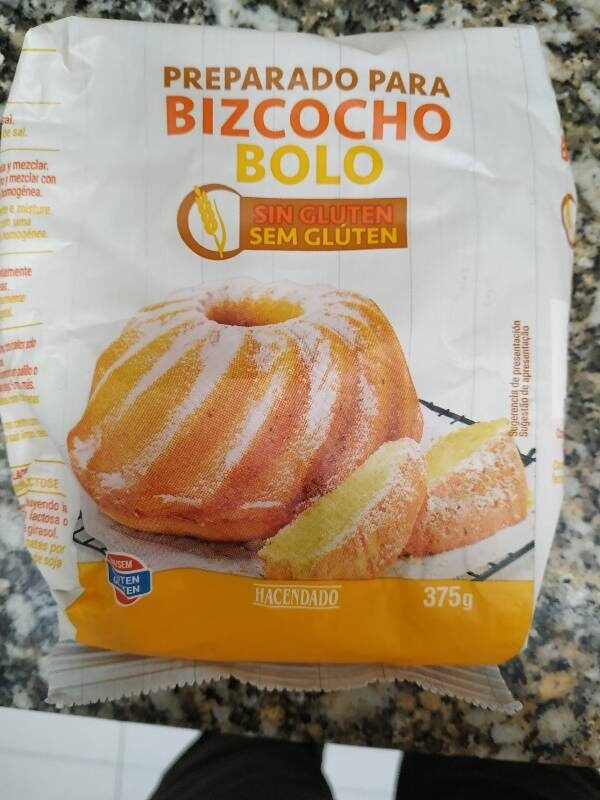
Preparado para bizcocho sin gluten – Hacendado

Preparado para bizcocho sin gluten – Hacendado

Aquesta pàgina del producte no està completa. Podeu ajudar a completar-la editant-la i afegint-hi més dades a partir de les fotos ja disponibles, o fent-ne més amb l'aplicació de androide o iPhone / iPad. Gràcies! ×

Codi de barres:
8480000291813(EAN / EAN-13)

Marques: Hacendado

Categories: Snacks, Aperitius dolços, Galetes i pastissos, Pastís, Ajudants de cuina, en:Dessert mixes, en:Pastry helpers, en:Baking Mixes, en:Cake mixes

Etiquetes, certificacions, premis: Lliure de gluten

Botigues: Mercadona

Països on es va vendre: Espanya

Matching with your preferences

Salut

Nutrició

  • icon

    Nutri-Score desconeguda

    Falta informació nutricional preparada
    ⚠ ️S'han d'especificar les dades nutricionals del producte per calcular el Nutri-Score.

    Informació nutricional que falta per al producte preparat: Energia, Greix, Proteïna, Àcid gras saturat, Sodi, Sucre

    Podries afegir la informació necessària per calcular el Nutri-Score?
    • icon

      Discover the new Nutri-Score!


      The computation of the Nutri-Score is evolving to provide better recommendations based on the latest scientific evidence.

      Main improvements:

      • Better score for some fatty fish and oils rich in good fats
      • Better score for whole products rich in fiber
      • Worse score for products containing a lot of salt or sugar
      • Worse score for red meat (compared to poultry)
    • icon

      What is the Nutri-Score?


      The Nutri-Score is a logo on the overall nutritional quality of products.

      The score from A to E is calculated based on nutrients and foods to favor (proteins, fiber, fruits, vegetables and legumes ...) and nutrients to limit (calories, saturated fat, sugars, salt). The score is calculated from the data of the nutrition facts table and the composition data (fruits, vegetables and legumes).

      The display of this logo is recommended by public health authorities without obligation for companies.

  • icon

    Informació nutricional


    Informació nutricional As sold
    per 100 g/100 ml
    Comparat amb: Pastís
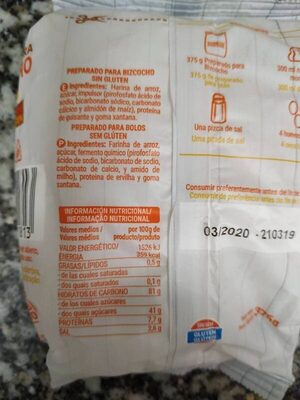
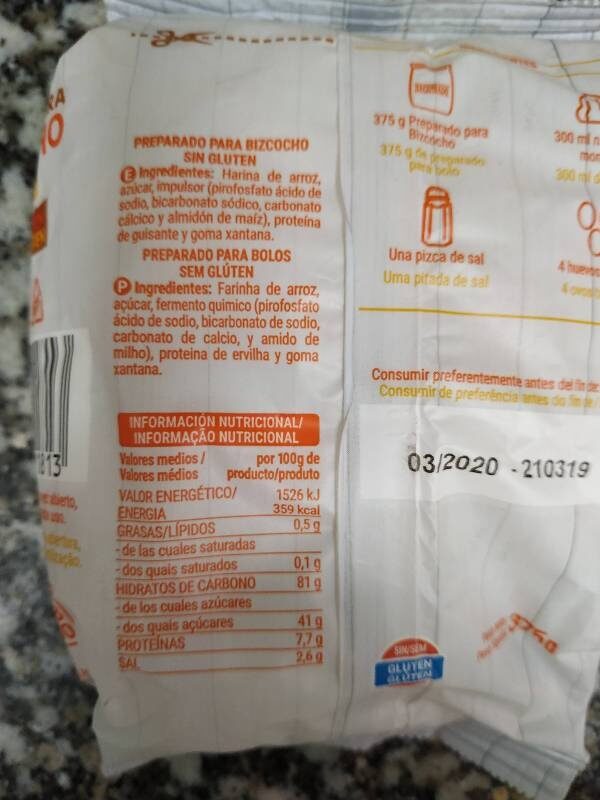
    Energia 1502 kJ
    (359 kcal)
    1.750,155 kj (419 kcal) (-14%)
    Greix 0.5 g 20,707 g (-98%)
    Àcid gras saturat 0.1 g 7,397 g (-99%)
    Hidrats de carboni 81 g 50,593 g (+60%)
    Sucre 41 g 25,407 g (+61%)
    Fiber ? 2,165 g
    Proteïna 7.7 g 5,573 g (+38%)
    Sal comuna 2.6 g 0,537 g (+384%)
    Sodi 1.04 g 0,216 g (+382%)
    Fruits‚ vegetables‚ legumes ? 0,139 %
    • Informació nutricional (Detailed data)


      Informació nutricional As sold
      per 100 g/100 ml
      As sold for 100 g (packaging)
      Energia 1502 kJ
      (359 kcal)
      ? kcal
      (359 kcal)
      Greix 0.5 g 0.5 g
      Àcid gras saturat 0.1 g 0.1 g
      Hidrats de carboni 81 g 81 g
      Sucre 41 g 41 g
      Fiber ? ?
      Proteïna 7.7 g 7.7 g
      Sal comuna 2.6 g 2.6 g
      Sodi 1.04 g 1.04 g
      Fruits‚ vegetables‚ legumes ? ?

Ingredients

  • icon

    9 ingredients


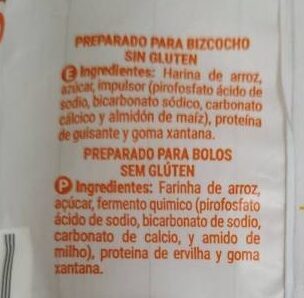
    Castellà: Harina de arroz, anica, impulsor (pirofosfato ácido de sodio, bicarbonato sódico, carbonato cálcico y almidón de maíz), proteína de guisante y goma xantana.
    • Ingredient information


      • Farina d'arròs: 60.0% (estimate)


      • anica: 20.0% (estimate)


      • impulsor: 10.0% (estimate)


      • — E450i: 5.0% (estimate)


      • — E500ii: 2.5% (estimate)


      • — E170i: < 2% (estimate)


      • — Midó de blat de moro: < 2% (estimate)


      • Proteïna de pèsol: 5.0% (estimate)


      • E415: 5.0% (estimate)


Processament d'aliments

Additius

  • E450 - Difosfat


  • E450i - Difosfat de disodi


  • E500 - Carbonats de sodi


    Sodium carbonate: Sodium carbonate, Na2CO3, -also known as washing soda, soda ash and soda crystals, and in the monohydrate form as crystal carbonate- is the water-soluble sodium salt of carbonic acid. It most commonly occurs as a crystalline decahydrate, which readily effloresces to form a white powder, the monohydrate. Pure sodium carbonate is a white, odorless powder that is hygroscopic -absorbs moisture from the air-. It has a strongly alkaline taste, and forms a moderately basic solution in water. Sodium carbonate is well known domestically for its everyday use as a water softener. Historically it was extracted from the ashes of plants growing in sodium-rich soils, such as vegetation from the Middle East, kelp from Scotland and seaweed from Spain. Because the ashes of these sodium-rich plants were noticeably different from ashes of timber -used to create potash-, they became known as "soda ash". It is synthetically produced in large quantities from salt -sodium chloride- and limestone by a method known as the Solvay process. The manufacture of glass is one of the most important uses of sodium carbonate. Sodium carbonate acts as a flux for silica, lowering the melting point of the mixture to something achievable without special materials. This "soda glass" is mildly water-soluble, so some calcium carbonate is added to the melt mixture to make the glass produced insoluble. This type of glass is known as soda lime glass: "soda" for the sodium carbonate and "lime" for the calcium carbonate. Soda lime glass has been the most common form of glass for centuries. Sodium carbonate is also used as a relatively strong base in various settings. For example, it is used as a pH regulator to maintain stable alkaline conditions necessary for the action of the majority of photographic film developing agents. It acts as an alkali because when dissolved in water, it dissociates into the weak acid: carbonic acid and the strong alkali: sodium hydroxide. This gives sodium carbonate in solution the ability to attack metals such as aluminium with the release of hydrogen gas.It is a common additive in swimming pools used to raise the pH which can be lowered by chlorine tablets and other additives which contain acids. In cooking, it is sometimes used in place of sodium hydroxide for lyeing, especially with German pretzels and lye rolls. These dishes are treated with a solution of an alkaline substance to change the pH of the surface of the food and improve browning. In taxidermy, sodium carbonate added to boiling water will remove flesh from the bones of animal carcasses for trophy mounting or educational display. In chemistry, it is often used as an electrolyte. Electrolytes are usually salt-based, and sodium carbonate acts as a very good conductor in the process of electrolysis. In addition, unlike chloride ions, which form chlorine gas, carbonate ions are not corrosive to the anodes. It is also used as a primary standard for acid-base titrations because it is solid and air-stable, making it easy to weigh accurately.
    Origen: Wikipedia (Anglès)
  • E500ii - Bicarbonat de sodi


    Sodium carbonate: Sodium carbonate, Na2CO3, -also known as washing soda, soda ash and soda crystals, and in the monohydrate form as crystal carbonate- is the water-soluble sodium salt of carbonic acid. It most commonly occurs as a crystalline decahydrate, which readily effloresces to form a white powder, the monohydrate. Pure sodium carbonate is a white, odorless powder that is hygroscopic -absorbs moisture from the air-. It has a strongly alkaline taste, and forms a moderately basic solution in water. Sodium carbonate is well known domestically for its everyday use as a water softener. Historically it was extracted from the ashes of plants growing in sodium-rich soils, such as vegetation from the Middle East, kelp from Scotland and seaweed from Spain. Because the ashes of these sodium-rich plants were noticeably different from ashes of timber -used to create potash-, they became known as "soda ash". It is synthetically produced in large quantities from salt -sodium chloride- and limestone by a method known as the Solvay process. The manufacture of glass is one of the most important uses of sodium carbonate. Sodium carbonate acts as a flux for silica, lowering the melting point of the mixture to something achievable without special materials. This "soda glass" is mildly water-soluble, so some calcium carbonate is added to the melt mixture to make the glass produced insoluble. This type of glass is known as soda lime glass: "soda" for the sodium carbonate and "lime" for the calcium carbonate. Soda lime glass has been the most common form of glass for centuries. Sodium carbonate is also used as a relatively strong base in various settings. For example, it is used as a pH regulator to maintain stable alkaline conditions necessary for the action of the majority of photographic film developing agents. It acts as an alkali because when dissolved in water, it dissociates into the weak acid: carbonic acid and the strong alkali: sodium hydroxide. This gives sodium carbonate in solution the ability to attack metals such as aluminium with the release of hydrogen gas.It is a common additive in swimming pools used to raise the pH which can be lowered by chlorine tablets and other additives which contain acids. In cooking, it is sometimes used in place of sodium hydroxide for lyeing, especially with German pretzels and lye rolls. These dishes are treated with a solution of an alkaline substance to change the pH of the surface of the food and improve browning. In taxidermy, sodium carbonate added to boiling water will remove flesh from the bones of animal carcasses for trophy mounting or educational display. In chemistry, it is often used as an electrolyte. Electrolytes are usually salt-based, and sodium carbonate acts as a very good conductor in the process of electrolysis. In addition, unlike chloride ions, which form chlorine gas, carbonate ions are not corrosive to the anodes. It is also used as a primary standard for acid-base titrations because it is solid and air-stable, making it easy to weigh accurately.
    Origen: Wikipedia (Anglès)

Anàlisi dels ingredients

  • icon

    Es desconeix si conté oli de palma


    Ingredients no reconeguts: es:anica, es:impulsor

    Alguns ingredients no s'han pogut reconèixer.

    Necessitem la teva ajuda!

    Podeu ajudar-nos a reconèixer més ingredients i analitzar millor la llista d'ingredients d'aquest producte i d'altres mitjançant:

    • Editeu aquesta pàgina de producte per corregir les faltes d’ortografia de la llista d’ingredients i/o per eliminar els ingredients d’altres idiomes i frases que no estiguin relacionades amb els ingredients.
    • Afegiu entrades, sinònims o traduccions noves a les nostres llistes multilingües d’ingredients, mètodes de processament d’ingredients i etiquetes.

    Uniu-vos al canal #ingredients del nostre espai de discussió a Slack i/o apreneu sobre l'anàlisi dels ingredients en la nostra wiki, si voleu ajudar. Gràcies!

  • icon

    Es desconeix si és vegà


    Ingredients no reconeguts: es:anica, es:impulsor

    Alguns ingredients no s'han pogut reconèixer.

    Necessitem la teva ajuda!

    Podeu ajudar-nos a reconèixer més ingredients i analitzar millor la llista d'ingredients d'aquest producte i d'altres mitjançant:

    • Editeu aquesta pàgina de producte per corregir les faltes d’ortografia de la llista d’ingredients i/o per eliminar els ingredients d’altres idiomes i frases que no estiguin relacionades amb els ingredients.
    • Afegiu entrades, sinònims o traduccions noves a les nostres llistes multilingües d’ingredients, mètodes de processament d’ingredients i etiquetes.

    Uniu-vos al canal #ingredients del nostre espai de discussió a Slack i/o apreneu sobre l'anàlisi dels ingredients en la nostra wiki, si voleu ajudar. Gràcies!

  • icon

    Es desconeix si és vegetarià


    Ingredients no reconeguts: es:anica, es:impulsor

    Alguns ingredients no s'han pogut reconèixer.

    Necessitem la teva ajuda!

    Podeu ajudar-nos a reconèixer més ingredients i analitzar millor la llista d'ingredients d'aquest producte i d'altres mitjançant:

    • Editeu aquesta pàgina de producte per corregir les faltes d’ortografia de la llista d’ingredients i/o per eliminar els ingredients d’altres idiomes i frases que no estiguin relacionades amb els ingredients.
    • Afegiu entrades, sinònims o traduccions noves a les nostres llistes multilingües d’ingredients, mètodes de processament d’ingredients i etiquetes.

    Uniu-vos al canal #ingredients del nostre espai de discussió a Slack i/o apreneu sobre l'anàlisi dels ingredients en la nostra wiki, si voleu ajudar. Gràcies!

L'anàlisi es basa únicament en els ingredients enumerats i no té en compte els mètodes de processament.
  • icon

    Detalls de l'anàlisi dels ingredients

    Necessitem la teva ajuda!

    Alguns ingredients no s'han pogut reconèixer.

    Necessitem la teva ajuda!

    Podeu ajudar-nos a reconèixer més ingredients i analitzar millor la llista d'ingredients d'aquest producte i d'altres mitjançant:

    • Editeu aquesta pàgina de producte per corregir les faltes d’ortografia de la llista d’ingredients i/o per eliminar els ingredients d’altres idiomes i frases que no estiguin relacionades amb els ingredients.
    • Afegiu entrades, sinònims o traduccions noves a les nostres llistes multilingües d’ingredients, mètodes de processament d’ingredients i etiquetes.

    Uniu-vos al canal #ingredients del nostre espai de discussió a Slack i/o apreneu sobre l'anàlisi dels ingredients en la nostra wiki, si voleu ajudar. Gràcies!

    es: Harina de arroz, anica, impulsor (pirofosfato ácido de sodio, bicarbonato sódico, carbonato cálcico, almidón de maíz), proteína de guisante, goma xantana
    1. Harina de arroz -> en:rice-flour – vegan: yes – vegetarian: yes – ciqual_food_code: 9520 – percent_min: 20 – percent_estimate: 60 – percent_max: 100
    2. anica -> es:anica – percent_min: 0 – percent_estimate: 20 – percent_max: 50
    3. impulsor -> es:impulsor – percent_min: 0 – percent_estimate: 10 – percent_max: 33.3333333333333
      1. pirofosfato ácido de sodio -> en:e450i – vegan: yes – vegetarian: yes – percent_min: 0 – percent_estimate: 5 – percent_max: 33.3333333333333
      2. bicarbonato sódico -> en:e500ii – vegan: yes – vegetarian: yes – percent_min: 0 – percent_estimate: 2.5 – percent_max: 16.6666666666667
      3. carbonato cálcico -> en:e170i – vegan: maybe – vegetarian: maybe – percent_min: 0 – percent_estimate: 1.25 – percent_max: 11.1111111111111
      4. almidón de maíz -> en:corn-starch – vegan: yes – vegetarian: yes – ciqual_food_code: 9510 – percent_min: 0 – percent_estimate: 1.25 – percent_max: 8.33333333333333
    4. proteína de guisante -> en:pea-protein – vegan: yes – vegetarian: yes – percent_min: 0 – percent_estimate: 5 – percent_max: 25
    5. goma xantana -> en:e415 – vegan: yes – vegetarian: yes – percent_min: 0 – percent_estimate: 5 – percent_max: 20

Entorn

Empaquetament

Transport

Informa d'un problema

Fonts de dades

Producte afegit per elcoco
Última modificació de la pàgina del producte per guezguez-majed.
La pàgina del producte, també editada per elcoco.8e7abe07484a66a5c970e4b1b7ec4696, kiliweb, musarana, roboto-app, yuka.VklvSkZZQWx0c2NTaC9kbXB5blcrOHRINEtTWWNFK0ZDTHNXSVE9PQ, yuka.WUlBdERaVWVnZjRvcWR0bm9BblYvT044MVpDSFdGeTBlN0pJSVE9PQ.

Si les dades són incorrectes o incompletes, pot completar o corregir editant aquesta pàgina.